 Stable32Frequency Stability
AnalysisStable32Frequency Stability
Analysis
Stable32Frequency Stability
AnalysisStable32Frequency Stability
AnalysisStable32 is a Microsoft WindowsÒ program for the analysis of frequency
stability. It permits the entry, editing, simulation, analysis and plotting of
phase and frequency data, the calculation of drift and stability statistics,
and the plotting and printing of phase, frequency and time stability data. It
is used by leading government and commercial metrology laboratories around the
world.
Features
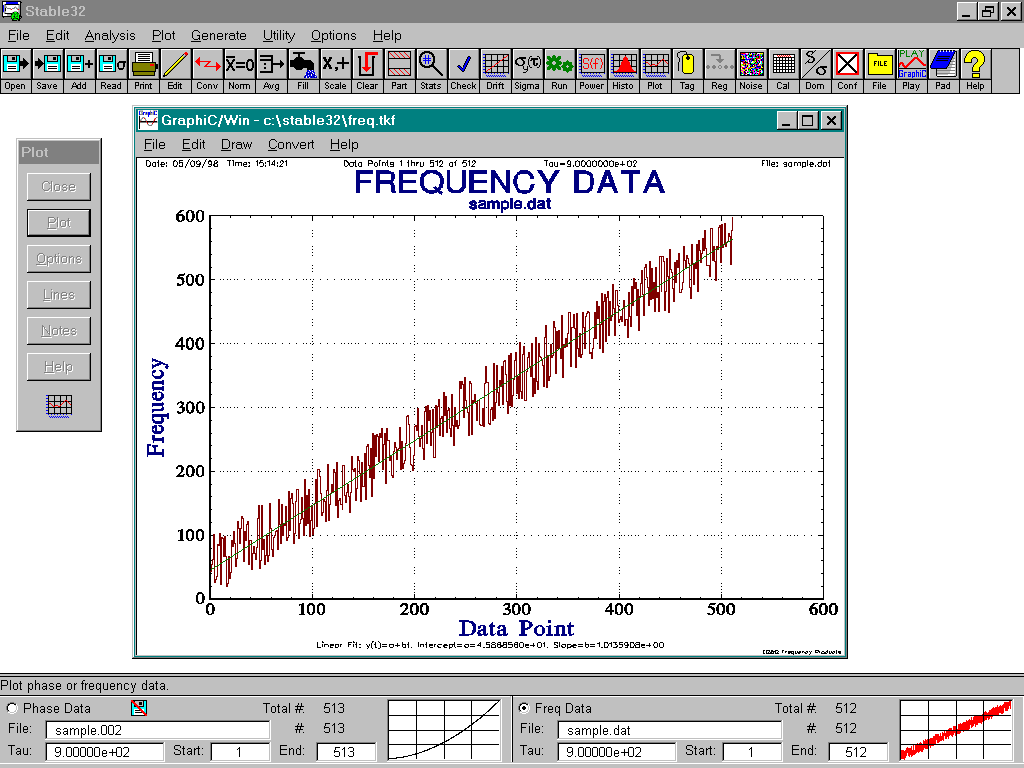
The Stable32 program includes all the functions necessary to manipulate, analyze and plot time and frequency stability data.
Stable32 file operations include opening phase and frequency data files, combining data, and storing all or a portion of the data. Data is stored in ASCII format, with gaps indicated by a value of zero, and may be input from any source that generates up to 8 columns of such comma or space-delimited data, with or without timetags. Stable32 can also read, index and process archive and database files from a Timing Solutions Corporation clock measurement system. All storage and calculations are performed with double precision for a virtually unlimited number of data points.
Editing features include displaying, editing, inserting, deleting, and filling gaps in phase and frequency data. Conversion between phase and frequency data is supported, as is outlier detection and removal. Timetags may be generated for indexing or used to locate and fill gaps in the data. Plotting and printing can be done for all or a portion of the data, with drift fits and automatic or user-defined scales and titles.
Analysis functions include basic statistics (maximum, minimum, average, median and standard deviation), drift, drift removal, normalization, scaling, gap and outlier detection and removal, as well as Allan, total and Hadamard variance stability statistics, histograms, and power spectrum, all over selectable limits with gaps ignored. Stability analysis includes point and automatic calculation and plotting of normal and overlapping Allan deviation, sy(t), modified Allan deviation, Mod sy(t), time deviation, sx(t), total deviation, stotal(t), modified total deviation, mod stotal(t), time total deviation, sx total(t) and normal, overlapping, and total Hadamard deviation, sH(t), Thêo1, ThêoBR, and ThêoH as well as MTIE and TIE rms. Telecom masks can be shown in MTIE plots. The PSD can be expressed as Sy(f), Sx(f), Sf(f) or £(f). Statistical techniques are available to estimate or define the noise type and to establish selectable confidence intervals. Stability data can be saved, edited, read and replotted. Simulated power-law clock noise may be generated, and time-frequency domain conversions may be done for power-law noise processes. A calendar is provided for date, day-of-year, GPS Week # and MJD.
Hardware Requirements
Stable32 runs on IBM-compatible PCs under Microsoft WindowsÒ 95 and higher. For best operation, it requires a 200 MHz PentiumÒ class or better computer with at least 32 MB of RAM and a 17" XGA color monitor. A graphics printer is needed for hard-copy plots.
Functions
All Stable32 functions are accessed by menus and toolbars as shown below:
File FunctionsEdit Functions
Analysis Functions
Plot
Generate
Utility
Tabs
Options
Help
Data Plotting
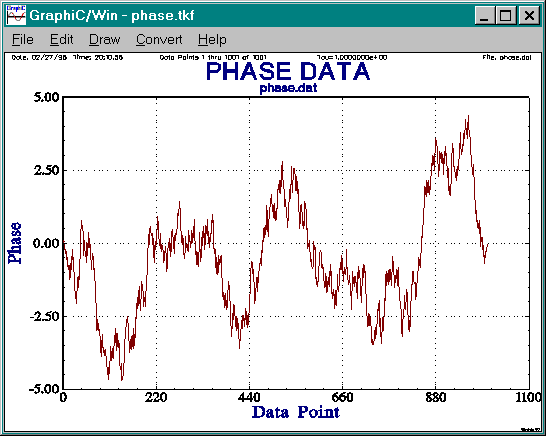
Stable32 includes functions for high resolution phase and frequency data plotting, with optional title, subtitle, annotations and drift lines. The data and time axes may be scaled to other units. The plot scales may be automatically determined or manually chosen. The plots include time and date, file name, data point range, averaging time and line parameters. A number of line options are available. The plotting routines use the GraphiCÒ library for on-screen and publication-quality hard copy graphic printouts. The screen plots may be zoomed, stored in a file for replay by the included Play/Win program, or converted to other formats for import into other programs.
Data Analysis
Stable32 includes functions for basic statistics, drift, variance, histograms and power spectrum analysis. The basic statistics are # data points and gaps, maximum, minimum, average, plot scales and standard deviation. Frequency drift analysis includes 2nd difference, 3-point and quadratic fits to phase data, and linear, bisection, logarithmic and diffusion fits to frequency data. Frequency drift may be removed from the phase or frequency data. Variance analysis includes normal, overlapping, modified and time Allan deviations, Total, and Hadamard deviations for phase and frequency data. The averaging time may be chosen as any multiple of the basic data up to the maximum permitted for the particular calculation. Confidence limits are given, and single or double confidence intervals can be established for overlapping data using C² statistics and the estimated noise type.
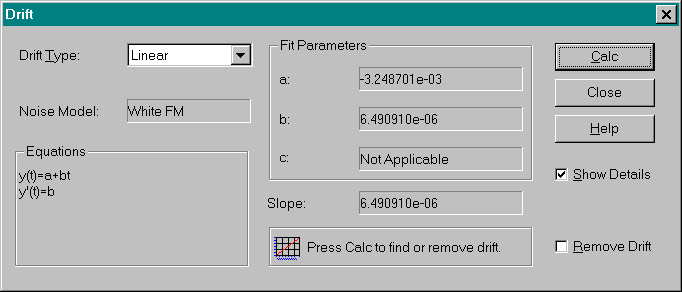
An example of a Stable32 drift analysis screen is shown below. This screen is typical of those for all Stable32 functions, including analysis choices and numerical results. The Stable32 drift analysis methods include linear, log, diffusion, bisection, quadratic, 3-point and 2nd difference. Linear fitting and endpoint matching is available to calculate and remove frequency offset from phase data.
Stability Analysis
Stable32 stability analysis methods include normal, overlapping, modified and time Allan deviations, total, modified and time total deviations, and normal, overlapping and total Hadamard deviations, as well as Thêo1, ThêoBR, ThêoH, Dynamic Allan and Hadamard stabilities, MTIE and TIE rms, as listed below:
Allan
Hadamard
Thêo1
Dynamic
Telecom
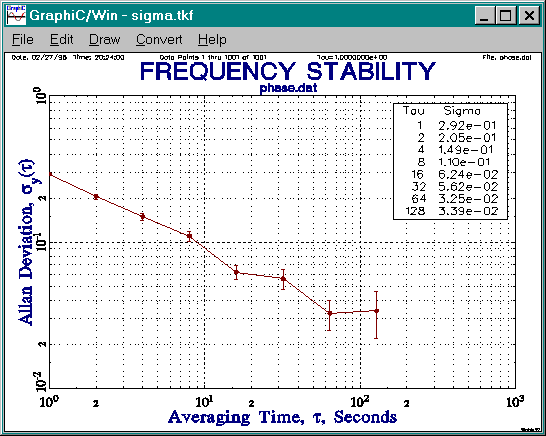
These statistics are available either at a single averaging time with the Sigma function, or over a range of averaging times with the Run function. The results of the latter operation can be printed in tabular form or plotted as shown below. Automatic or user-defined noise typing is available, and decade, octave or all tau increments may be selected.
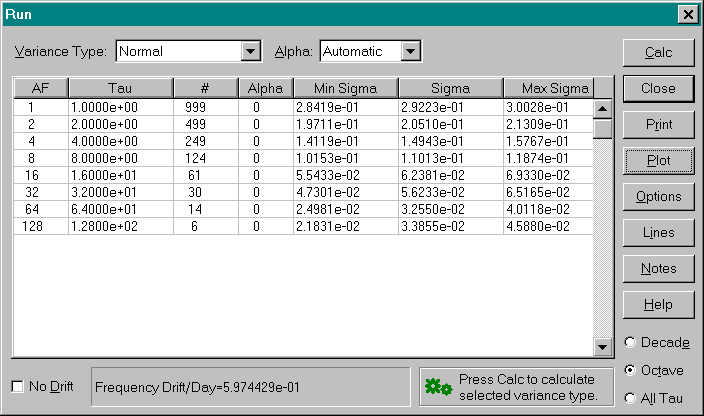
The stability plot can include noise lines, specification limits, telecom masks, and a variety of titles, sub-titles, messages and annotations.
Other Functions
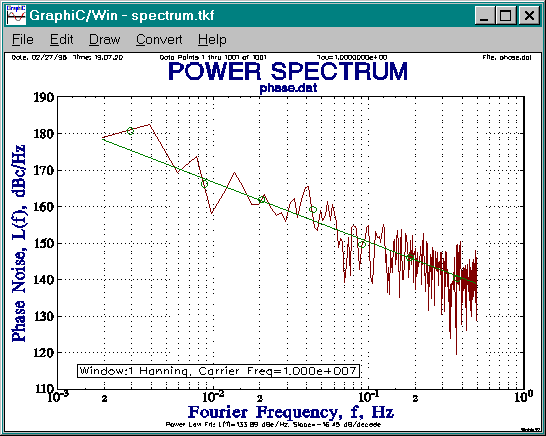
Other Stable32 analysis functions include autocorrelation, power spectra, Sy(f), £(f), Sf(f) and Sx(f), histograms and time-frequency domain conversions. In addition, simulated power law clock noise may be identified, generated and analyzed.
Documentation
Stable32 is supported by a 300+ page printed User Manual that fully describes the installation, operation, and theory of the program. Examples are included that show the use of the major features and functions. Stable32 can be used for both routine data analysis of frequency stability measurements and as an educational tool. The ability to generate and analyze simulated clock noise is an effective way to learn the techniques of frequency stability analysis. The Stable32 program also includes on-line help. A number of papers are available on-line to support the use of Stable32. Printed copies of the Stable32 User Manual may be purchased for U.S. $20 at http://www.lulu.com/content/212944
Price
The price of Stable32 (which includes domestic shipping via priority
U.S. mail and free updates for at least 1-year) is shown in the following
table. Site licenses are also available - please contact us for further
information. Foreign shipping by air mail costs U.S $25 per copy. Shipping via
package delivery service (UPS or FedEx) is billed at approximate
cost.
|
|
|
|
|
|
|
|
|
|
|
|
Ordering Information
The Stable32 software package may be bought directly from Hamilton Technical Services. You can place a purchase order by mail, fax or e-mail. Delivery of the latest version is usually from made from stock, and orders shipped on the same or next business day. Payment can be made by check, funds transfer or PayPal. Bank information will be included on the invoice. Credit cards can be used with PayPal. Please provide both shipping and billing addresses. Stable32 is supplied on a CD-ROM with an installation program and is not copy protected. Backup copies may be made and the program may be installed on any number of computers within the immediate user group that purchased it, but only one copy of each unit purchased may be used at any time. Site licenses are also available. Additional copies of the software or its documentation may not be distributed to others. Stable32 is sold with a 30-day refund policy to insure your satisfaction. Free e-mail support and update downloads are provided for at least 1 year.
Order Form
Date _____________________________________________
Name ____________________________________________ Title _________________________________
E-Mail Address _________________________________________________________________________
Company _________________________________________ Mail Code ____________________________
Address ________________________________________________________________________________
Address ____________________________________________________________________________-___
City ______________________________________________ State _____________ Zip _______________
Country __________________________________________ Telephone ________________________-____
Quantity ________ Price: (See Table Above) Total Cost US $ _______________________
Mail order to:
Hamilton Technical Services
650 Distant Island Drive
Beaufort, SC
29907-1580 USA
Telephone: +1-843-525-6495
Fax: +1-843-525-0251
E-Mail:
bill@wriley.com